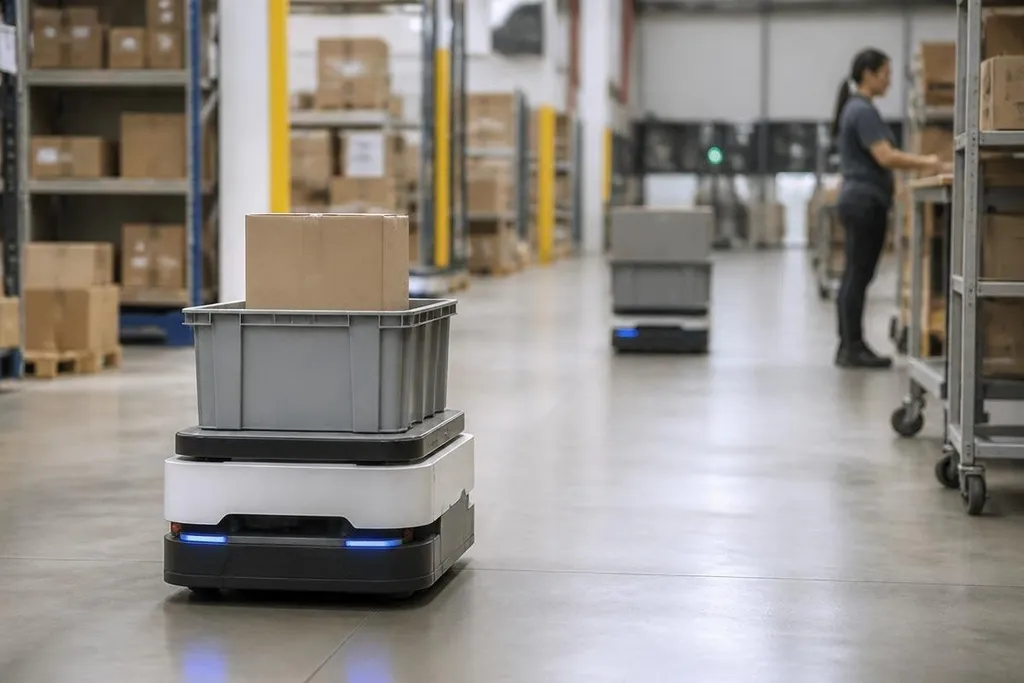
A shipping robot can move through a site, carry goods, or sort parcels. That description says little about whether it can earn its place on a working floor, where routes change, loads vary, and people share the same space.
For an operations manager comparing autonomous systems, the useful question is narrower: what task can the robot repeat, at what cost, and with how much human help?
- Test the task: name the load, route, handoff, and work rate.
- Price the full system: include software, site changes, service, and staff time.
- Check the failure plan: find out what happens after a blocked route or missed pickup.
Start with the job, not the robot
Shipping work has a clear sequence. A robot may collect a tote, move a pallet, bring a parcel to a packing station, or sort items by destination. Each task needs its own test because the hardware, sensors, and software face different problems.
Write the task as a short chain of actions. The robot must receive an order, find the load, pick it up, travel to the next point, and hand it over. If a person must take over at any stage, record when and why it happens.
That record matters more than a smooth demonstration. A short video can show motion, but it may leave out setup time, remote control, failed runs, or the work needed after a mistake.
Measure the handoffs
A robot rarely works alone. It must pass goods to a conveyor, a worker, another robot, or a storage system. The handoff can set the pace for the whole task, especially when a load arrives in the wrong position or a barcode cannot be read.
Ask for the full work rate, not the robot's travel speed. Count the time to load, move, stop, wait, unload, and return. Then record how often a person steps in. A fast trip means little if the robot waits at the station for most of the cycle.
The same test should run with the loads you handle. Boxes with damaged labels, uneven weight, loose wrapping, and different sizes can change the result. A supplier that gives only one ideal load has left out part of the work.
Price the system you will run
The purchase price is one line in the budget. You may also need charging equipment, network work, floor changes, safety checks, software fees, staff training, and service visits.
Ask the supplier to list each item and state which costs repeat each month or year. The staffing question needs the same care, since a system may need one person to watch several robots or a worker beside each handoff.
Count that time during normal work and during faults. This gives you a cost per completed task instead of a price built from a brochure.
A shipping robot’s price means little without a record of the task, site, and test date. Use shipping robotics reporting from Robot24.com to compare those details with the company’s claim before the next section asks what still needs proof.
What still needs proof
The label “new shipping robot” doesn't answer the hard questions. Ask for records from a site with a similar load and task. Check how long the system has run, how often it stopped, and who fixed each fault.
You also need a clear answer on data and control. Find out what the robot records, where that data sits, and whether a remote operator can take control. Ask what happens if the network drops or a sensor becomes dirty.
A supplier may show a robot completing a task under close supervision. That can prove the task is possible. It doesn't prove the same result will hold across a full shift with normal interruptions.
A buyer's check before a pilot
Use this list before signing a pilot plan. Each point should have a written answer and a way to measure it.
- Name the load: set weight, size, packaging, and label limits.
- Set the route: map pickup points, drop-off points, crossings, and waiting areas.
- Count human help: record every manual recovery and the minutes it takes.
- Price the site: list power, network, floor work, software, training, and service.
- Set the stop rule: agree on the result that ends the pilot or sends the system back for changes.
I'd wait for that written test before buying a robot sold mainly through a polished demo.
The next useful proof is a published shift record: completed tasks, human interventions, stop time, and full operating cost. Until suppliers show those numbers for the load you actually ship, the label matters less than the handoff at the end of the route.